
If your car pulls slightly to one side, the steering wheel feels unusual, or you notice vibration while driving, you may hear two terms from a tyre professional: wheel alignment and wheel balancing.
Although these services are often mentioned together, they solve different problems.
Wheel alignment is primarily about adjusting the angles of the wheels according to the vehicle manufacturer’s specifications. Wheel balancing deals with the distribution of weight around the tyre-and-wheel assembly so that it can rotate smoothly.
Understanding the difference can help you ask for the right inspection instead of assuming that every tyre or steering problem requires the same service.
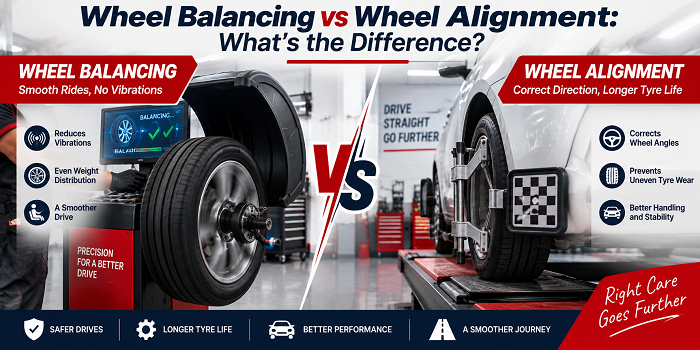
Wheel Balancing vs Wheel Alignment:
Here’s the simplest way to understand the difference:
| Wheel Alignment | Wheel Balancing |
| Adjusts wheel angles | Corrects uneven weight distribution |
| Related to vehicle suspension geometry | Related to the tyre-and-wheel assembly |
| Can affect steering direction | Can cause vibration when out of balance |
| Uneven tyre wear can be a warning sign | Vibration can be a warning sign |
| Can be affected by potholes and kerb impacts | Often performed when tyres are fitted or remounted |
| Uses alignment equipment | Uses a wheel balancing machine and weights |
In simple terms:
Alignment helps make sure the wheels are pointing and tracking correctly. Balancing helps the tyre and wheel rotate smoothly without unnecessary vibration.
These services complement each other, but one does not replace the other.
What Is Wheel Alignment?
Wheel alignment involves checking and, where necessary, adjusting the angles of the wheels relative to the vehicle and road.
The objective is to bring the relevant alignment angles within the vehicle manufacturer’s specified range. Common alignment measurements include toe, camber, and caster, although the exact adjustments depend on the vehicle.
A proper wheel alignment service is therefore not simply about making the steering wheel look straight. It involves checking the vehicle’s wheel geometry and making appropriate adjustments.
What Does Wheel Alignment Adjust?
Depending on the vehicle, an alignment check can involve measurements such as:
Toe
Toe describes whether the wheels on an axle point slightly inward or outward when viewed from above.
Incorrect toe settings can contribute to irregular tyre wear.
Camber
Camber refers to the inward or outward tilt of the wheel when viewed from the front.
Excessive camber can contribute to wear on the inner or outer portion of the tyre tread.
Caster
Caster is another steering geometry angle that can influence steering behaviour and stability. The ability to adjust caster depends on the vehicle’s design.
Signs You May Need Wheel Alignment
One of the most common reasons drivers search for wheel alignment Dubai is a noticeable change in how their car steers or how the tyres are wearing.
Possible warning signs include:
- Car pulling or drifting to one side
- Steering wheel remaining off-centre while driving straight
- Uneven tyre wear
- Abnormal shoulder wear
- Changes in steering or handling
- A noticeable change after hitting a major pothole or kerb
Michelin recommends having alignment checked when abnormal tyre wear or steering/handling problems occur, after significant impacts and when suspension or steering components are replaced.
However, these symptoms can have other causes too. For example, a vehicle pulling to one side does not automatically prove that alignment is the problem. A professional inspection is the better way to identify the cause.
What Is Wheel Balancing?
Wheel balancing addresses the distribution of weight around the tyre-and-wheel assembly.
Even when a tyre and wheel look perfectly normal, their combined weight may not be distributed equally around the assembly. A balancing machine identifies the imbalance, and appropriate weights are placed on the wheel to compensate for it.
A Wheel balancing service is therefore mainly concerned with smooth rotation rather than changing the direction in which the wheels point.
How Does Wheel Balancing Work?
The tyre and wheel assembly is mounted on a balancing machine.
The machine identifies where the weight distribution is uneven. The technician then adds appropriate balancing weights to compensate for the imbalance.
The goal is to allow the assembly to rotate more evenly and reduce unwanted vibration.
Michelin notes that balancing is normally carried out when tyres are fitted or remounted and that an impact such as a kerb strike can also mean the wheel needs to be rebalanced.
Signs You May Need Wheel Balancing
The most recognisable symptom of an imbalance is vibration.
You may feel vibration through:
- The steering wheel
- The floor
- The dashboard
- The seats
Sometimes the vibration becomes more noticeable at particular speeds.
Michelin notes that an unbalanced tyre-and-wheel assembly can cause vibration and that persistent vibration may also require inspection of alignment, steering or suspension components.
So if you experience vibration, don’t automatically assume that balancing is the only possible solution.
Wheel Alignment vs Wheel Balancing: Key Differences
The easiest way to remember the distinction is:
Alignment = direction and geometry
It concerns how the wheels are positioned and angled relative to the vehicle.
Balancing = weight distribution
It concerns how evenly the tyre, and wheel assembly rotates.
This difference is particularly important when visiting a Dubai tyre shop because asking for “alignment and balancing” without explaining your symptoms may not provide the technician with enough information to identify the actual problem.
A professional workshop should inspect the vehicle and determine which service or combination of services is appropriate.
Can You Need Both Wheel Alignment and Balancing?
Yes.
A vehicle can have both an alignment issue and a wheel imbalance at the same time.
For example, imagine that a driver has recently hit a pothole. The impact could potentially affect the wheel, tyre or suspension and may contribute to an alignment problem or imbalance.
Similarly, if you install new tyres, balancing is normally performed as part of the tyre fitting process, while alignment may be checked when there are relevant symptoms or reasons to inspect it.
That’s why alignment and balancing should not be treated as interchangeable services.
When Should You Get a Wheel Alignment Service?
There is no single universal interval that applies to every vehicle.
Instead, consider having your alignment checked when:
- The vehicle pulls to one side.
- The steering wheel is not centred while driving straight.
- You notice abnormal or uneven tyre wear.
- You have hit a significant pothole or kerb.
- Steering or handling feels different.
- Steering or suspension components have been replaced.
- You install new tyres and want to check the vehicle’s geometry.
Michelin specifically lists these situations as reasons to check wheel alignment.
For drivers looking for wheel alignment Dubai, the important point is to choose a service provider with appropriate alignment equipment and manufacturer specifications for the vehicle.
When Should You Get a Wheel Balancing Service?
Balancing is commonly performed when:
- New tyres are fitted.
- Existing tyres are removed and refitted.
- A balance weight is lost or moved.
- You experience vibration.
- A wheel has experienced an impact.
- A tyre professional identifies imbalance during inspection.
Michelin states that tyres should be balanced when they are mounted on wheels for the first time or remounted after repair.
If you notice vibration after tyre installation, a Wheel balancing service can be one of the checks performed to identify the cause.
Why Wheel Alignment and Balancing Matter in Dubai
Dubai drivers regularly use a combination of city streets, highways, and busy routes. Potholes, kerbs and road impacts can affect wheels, tyres, and suspension components.
Misalignment can develop after hitting a kerb or pothole, while wheel imbalance can occur through changes in the tyre-and-wheel assembly or after an impact.
This makes it useful to pay attention to changes in:
- Steering
- Handling
- Tyre wear
- Vibration
- Ride smoothness
Regular visual tyre inspections and professional checks when symptoms appear can help identify problems before they lead to more significant tyre wear.
Wheel Alignment and Balancing After New Tyres
When you purchase new tyres, balancing should normally be part of the fitting process because the tyre, and wheel assembly needs to be balanced after mounting.
Alignment is different.
New tyres do not automatically mean that your vehicle has an alignment problem. However, checking alignment can be appropriate when there are symptoms, abnormal wear, an impact history or steering/suspension work.
This distinction can help you understand what a tyre service provider is recommending and why.
How to Choose the Right Service
Instead of choosing between alignment and balancing based solely on price, start with the symptom.
If you notice:
Car pulling to one side
→ Have wheel alignment and steering/suspension condition checked.
Uneven tyre wear
→ Have tyre condition and alignment checked.
Steering-wheel vibration
→ Have wheel balance, tyres, and wheels checked.
Vibration continues after balancing
→ Alignment, suspension, and other possible causes may need inspection.
New tyres being fitted
→ Balancing should normally be performed as part of fitting.
Major pothole or kerb impact
→ Have the tyre, wheel, and alignment condition assessed if you notice changes afterward.
This approach is more useful than assuming that every problem requires both services.
Wheel Maintenance Checklist for Dubai Drivers
A simple routine can help you monitor your tyres, and wheels.
Check regularly
- Look for uneven tyre wear.
- Check tyre pressure according to the vehicle manufacturer’s recommendation.
- Inspect tyres for visible damage.
- Pay attention to new vibrations.
- Notice whether the car pulls to one side.
- Check whether the steering wheel remains centred when driving straight.
After a pothole or kerb impact
Pay attention to:
- New vibration
- Steering changes
- Pulling to one side
- Visible wheel or tyre damage
- Changes in tyre wear
If something feels different after an impact, professional inspection is advisable.
What About Wheel Alignment and Balancing Prices in Dubai?
The cost can vary depending on the vehicle, workshop, equipment, service required, and whether additional repairs are necessary.
Rather than comparing only the lowest advertised price, ask what the service includes.
For a wheel alignment service, ask whether the workshop performs a proper alignment measurement and adjustment according to vehicle specifications.
For balancing, ask whether the tyre-and-wheel assembly will be checked using a balancing machine and whether balancing weights are included.
This makes price comparisons more meaningful because you are comparing the actual service rather than just a headline price.
Wheel Alignment and Balancing at Tyre Experts
Tyre Experts/F&T Auto Services lists wheel alignment and balancing among its vehicle services in Dubai. Its website states that its technicians use alignment equipment and aim to align wheels according to manufacturer specifications.
Its tyre service page also states that tyre fitting includes proper fitting and balancing.
For readers comparing a wheel alignment service or balancing service in Dubai, the important step is to explain the symptoms you are experiencing and allow the technician to inspect the vehicle before deciding which service is appropriate.
Final Thoughts
Wheel alignment and wheel balancing are different services designed to address different issues.
Alignment focuses on wheel angles and vehicle geometry, while balancing focuses on weight distribution within the tyre-and-wheel assembly. Alignment problems are commonly associated with symptoms such as pulling and uneven tyre wear, while imbalance can produce vibration.
Sometimes a vehicle needs only one of these services. In other cases, both may be appropriate.
The best approach is to pay attention to changes in steering, vibration, handling, and tyre wear and have the vehicle professionally inspected when something doesn’t feel right.
For Dubai drivers searching for wheel alignment Dubai, wheel alignment and balancing, or a Wheel balancing service, understanding this difference makes it easier to communicate with a tyre professional and choose the appropriate inspection or service.
Frequently Asked Questions
1. What is the difference between wheel alignment and wheel balancing?
Wheel alignment adjusts the angles of the wheels according to the vehicle’s specifications. Wheel balancing corrects uneven weight distribution in the tyre-and-wheel assembly.
2. Is wheel alignment and balancing the same thing?
No. They address different aspects of wheel and tyre performance. Alignment concerns wheel geometry, while balancing concerns the distribution of weight around the tyre and wheel.
3. How do I know if my car needs wheel alignment?
Common signs include pulling to one side, an off-centre steering wheel, abnormal tyre wear, and changes in steering or handling. These symptoms can have other causes, so professional inspection is recommended.
4. How do I know if my wheels need balancing?
Vibration or wobbling, particularly at certain speeds, can indicate an imbalance. However, vibration can have other causes, so a professional diagnosis is important.
5. Can wheel balancing fix steering vibration?
It can if the vibration is caused by an imbalance in the tyre-and-wheel assembly. If vibration remains after balancing, other causes such as alignment, wheel, or suspension problems may need to be investigated.
6. Does wheel alignment fix uneven tyre wear?
Correct alignment can help prevent alignment-related uneven wear, but the exact cause should be diagnosed first. Incorrect tyre pressure, suspension problems, and other issues can also contribute to uneven wear.
7. Do I need balancing when I buy new tyres?
Balancing is normally performed when tyres are mounted or remounted because the tyre-and-wheel assembly may have uneven weight distribution.
8. Do I need wheel alignment after changing tyres?
Not necessarily. New tyres do not automatically mean the vehicle is misaligned. However, alignment may be worth checking if there is uneven wear, steering/handling trouble, a recent impact or suspension/steering work.
9. Can potholes affect wheel alignment?
Yes. Significant pothole or kerb impacts can contribute to misalignment and can also affect wheels, tyres or suspension components.
10. Can I need both alignment and balancing?
Yes. Because the services address different problems, a vehicle can require both. A professional inspection can determine whether one or both services are appropriate.
11. How often should wheel alignment be checked in Dubai?
There is no single interval suitable for every vehicle. Alignment should be checked when symptoms such as uneven wear, pulling or steering changes appear, after significant impacts, and when relevant suspension or steering components are replaced.
12. How often should wheels be balanced?
Balancing is normally performed when tyres are mounted or remounted. It should also be checked if vibration develops or if a wheel/tyre has experienced an event that could affect balance.